AWS Architecture Review Checklist Before Production
A practical AWS architecture review checklist for security, resilience, scaling, observability, recovery, and cost before a workload reaches production.
- AWS
- Architecture
- Cloud Architecture
- Production Readiness
- Security
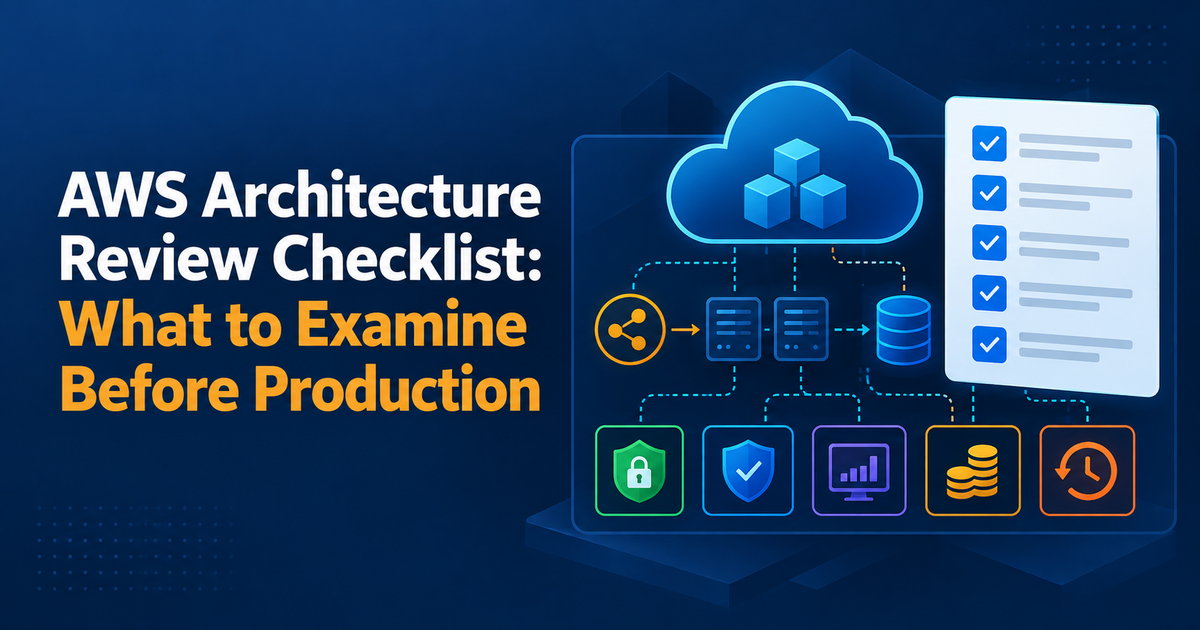
AWS Architecture Review Checklist: What to Examine Before Production
A workload can deploy successfully and still be unready for production. Before launch, the useful question is not simply “does it work?” but “what happens when traffic grows, a dependency fails, credentials leak, or someone needs to restore data?”
An architecture review should make those failure modes explicit while there is still time to change the design.
Review the workload as a system
Avoid reviewing AWS services as isolated boxes. Trace real paths through the architecture: an incoming request, an asynchronous job, a database write, a deployment, and a recovery operation. A secure Lambda function can still sit behind an unprotected API; a Multi-AZ database does little for availability if the application runs on one instance.
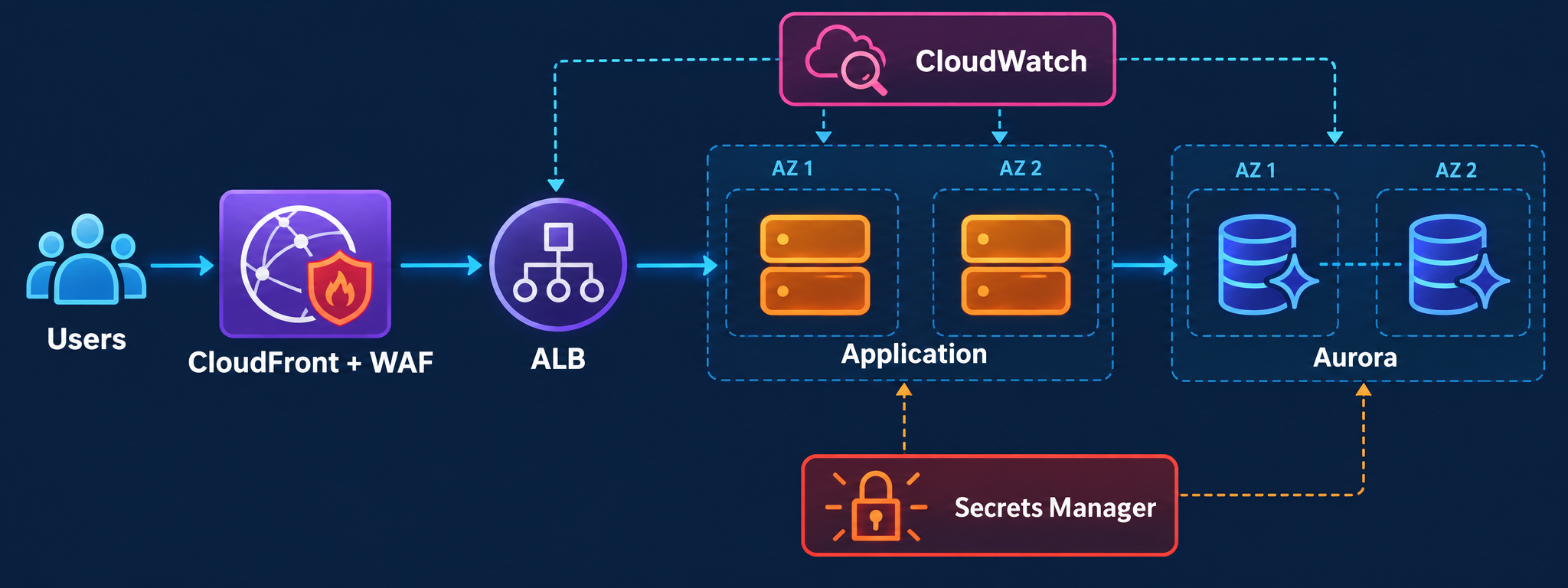
For each important path, examine five areas.
1. Security and access
Start with exposure and identity. Which resources are reachable from the internet? Are workloads in public subnets because they must be, or because it was convenient? Check IAM roles for broad permissions, security-group rules, encryption, secret storage, and authentication at every public entry point.
Least privilege means granting only the actions and resources a principal actually needs. Pay particular attention to wildcard IAM permissions and credentials stored in Lambda environment variables, source code, or deployment configuration.
2. Reliability and failure behavior
Ask what happens when each dependency becomes unavailable. Look for single-AZ components, queues without dead-letter queues (DLQs), missing retry limits, and synchronous chains where one slow service can exhaust upstream capacity.
For SQS-driven workloads, verify that visibility timeout fits the real processing time and that consumers are idempotent—safe to run more than once for the same message. For databases, review backups, failover design, and actual restore procedures, not only whether backups are enabled.
3. Scaling and performance boundaries
Autoscaling moves bottlenecks; it does not remove them. A Lambda function may scale faster than Aurora can accept connections. An Application Load Balancer may distribute traffic correctly while a downstream API hits a rate limit.
Identify quotas, connection pools, concurrency limits, timeouts, throttling, cache behavior, queue depth, and database capacity. Define where backpressure occurs when demand exceeds capacity.
4. Observability and operations
Production systems need enough evidence to answer: what failed, where, for whom, and since when? Review application logs, CloudWatch metrics, alarms, distributed tracing where useful, dashboards, and retention periods.
An alarm should lead to an action. High CPU alone may not explain a customer-facing failure; latency, error rate, throttling, queue age, database connections, and dependency errors often provide better context.
5. Cost and recovery
Estimate the cost shape, not just the current bill. NAT Gateways, cross-AZ traffic, high-volume logging, idle resources, oversized databases, and aggressive retention can become significant as usage changes.
Then define recovery objectives. Recovery Time Objective (RTO) is how quickly service must be restored; Recovery Point Objective (RPO) is how much data loss is acceptable. The architecture, backup schedule, and recovery process should support those targets.
A practical pre-production workflow
Use a short review sequence rather than a giant questionnaire:
- Draw the deployed architecture from actual AWS resources.
- Trace the critical request and event paths end to end.
- Identify public exposure, trust boundaries, and privileged access.
- Break one dependency at a time conceptually and document the resulting behavior.
- Check scaling limits from the edge through compute to storage.
- Verify that logs, metrics, alarms, backups, and restore procedures cover the critical paths.
- Record findings with severity, affected resource, evidence, and a concrete remediation.
Example: a web application that looks ready
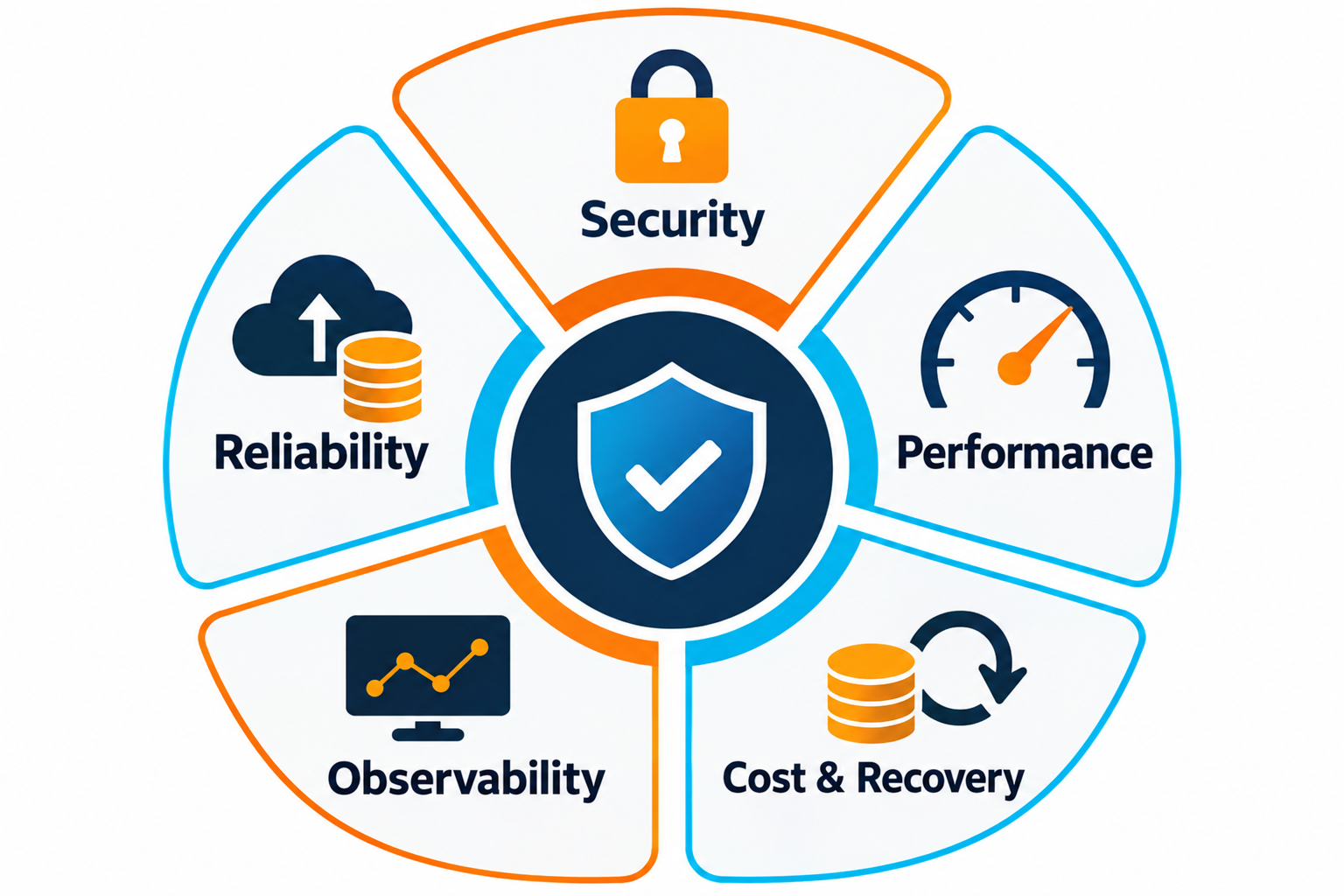
Consider CloudFront and AWS WAF in front of an Application Load Balancer, application compute across two Availability Zones, and Aurora behind it. On paper, the design looks resilient.
A review might still find that the application security group accepts traffic from more sources than the load balancer, database credentials are stored in application configuration, alarms cover CPU but not HTTP 5xx errors, and Aurora backups exist but nobody has tested a restore.
None of those findings requires redesigning everything. They require specific changes: restrict network paths, move credentials to a managed secret, alarm on customer-visible failure signals, and test recovery before production depends on it.
Trade-offs and common mistakes
The goal is not maximum redundancy everywhere. Multi-Region failover, extra replicas, longer log retention, and more monitoring all add cost and operational complexity. Match controls to business impact and recovery requirements.
The common mistake is treating the review as a pass/fail compliance exercise. A useful review produces a prioritized list: what must be fixed before launch, what can be accepted temporarily, who owns it, and when it will be revisited.
Before you approve production
A production review is valuable when it turns architecture assumptions into explicit failure behavior, limits, and actions. Trace the real workload, prioritize findings by impact and likelihood, and make unresolved risk visible to the people approving the launch.
If keeping that picture current is the hard part, ArchNube.com is built around it. ArchNube Assess connects through a narrow, read-only, customer-controlled IAM role, discovers supported AWS resources, and applies deterministic rules to produce explainable architecture findings—without write access to the account or black-box AI judgment.
Related Insights
- AWS
- Architecture
Common AWS Architecture Risks That Are Easy to Miss
A practical AWS architecture review of failure paths, scaling limits, access boundaries, recovery gaps, and cost risks that teams often overlook.
- AWS
- Architecture
Your AWS Architecture Changed. Would You Know?
Learn a practical way to detect AWS architecture drift, compare resource snapshots, trace changes, and review the ones that actually affect risk.
- AWS
- Architecture
The First 10 Things I Review in an Existing AWS Account
A practical 10-point AWS account review covering identity, networking, resilience, observability, operations, and cost before making changes.