
Common AWS Architecture Risks That Are Easy to Miss
A practical AWS architecture review of failure paths, scaling limits, access boundaries, recovery gaps, and cost risks that teams often overlook.
- AWS
- Architecture
- Cloud Security
- Resilience
- Cloud Cost
Common AWS Architecture Risks That Are Easy to Miss
Most AWS architecture problems are not caused by an obviously bad diagram. They come from reasonable services connected in ways that leave a failure path, scaling mismatch, security exposure, or recovery gap.
The useful question is not only “does this architecture work?” but “what happens when one assumption stops being true?”
Look at the connections, not just the services
A Lambda function, SQS queue, RDS database, or API Gateway can each be configured correctly in isolation while the system around them is still fragile.
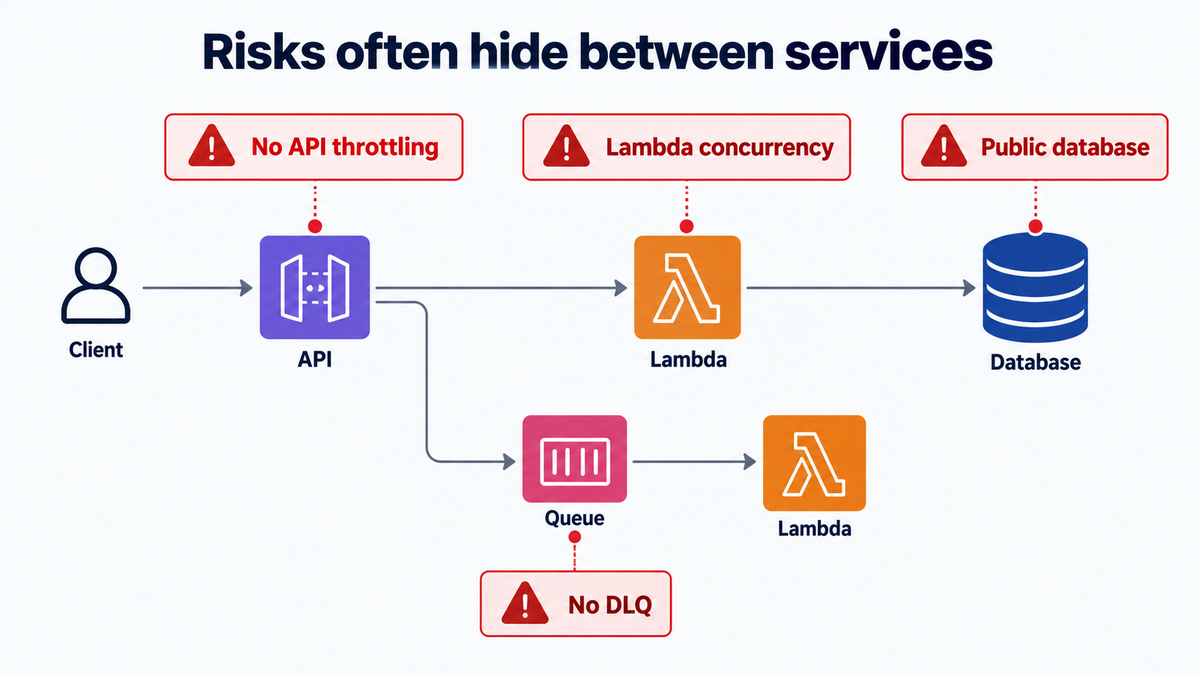
For example, an asynchronous Lambda workflow may work perfectly during normal traffic. If failed events have nowhere to go, however, a transient downstream problem can become lost work or repeated processing. Similarly, Lambda can scale much faster than a relational database can accept new connections.
Several risks deserve an explicit check:
- Missing failure destinations. Queues and asynchronous workloads need a deliberate failure path. For SQS, that commonly means a dead-letter queue (DLQ) and a sensible redrive policy.
- Scaling mismatches. Serverless compute can add concurrency quickly while a database, downstream API, or legacy service has a much lower safe limit.
- Weak recovery assumptions. “Backups are enabled” is different from knowing that the data can be restored within the required recovery time objective (RTO) and recovery point objective (RPO).
- Overly broad access. Wildcard IAM permissions, unnecessarily public resources, and permissive security-group rules can survive because the application still works.
- Secrets in configuration. Credentials placed directly in Lambda environment variables or deployment configuration are harder to rotate and easier to expose than secrets managed through a dedicated secrets service.
- Missing operational limits. API throttling, Lambda concurrency controls, queue visibility timeouts, database connection limits, and service quotas are architecture decisions even when they are absent from the diagram.
- Quiet cost traps. NAT gateways, unused Elastic IP addresses, excessive log retention, and over-provisioned resources can be technically valid and still be poor architectural choices.
A practical review workflow
Reviewing an AWS account service by service is useful, but it is not enough. Review behavior across the workload as well.
- Trace each request and event path. Follow synchronous requests, asynchronous messages, scheduled jobs, and data flows from entry point to final dependency.
- Ask how every step fails. Identify retries, timeouts, DLQs, idempotency requirements, fallback behavior, and where an operator can see the failure.
- Compare scaling boundaries. Find the fastest-scaling component, then check whether every downstream dependency can absorb that load.
- Review trust boundaries. Check public exposure, security groups, resource policies, IAM permissions, encryption, and where secrets live.
- Test the recovery story. Identify backup configuration, retention, restore procedures, Multi-AZ or multi-region assumptions, and the actual RTO/RPO requirement.
- Review cost as architecture. Look for resources whose cost continues even when application traffic is low, plus patterns where scale multiplies spend unexpectedly.

Example: a healthy API with a hidden database risk
Consider an API Gateway endpoint invoking Lambda, with Lambda writing to Aurora. Traffic is modest, errors are low, and CPU on the database looks healthy.
Then a campaign causes a sudden traffic spike. Lambda increases concurrency and each execution opens a database connection. The database reaches its connection limit before CPU becomes the bottleneck. The API begins failing even though every service looked healthy during the earlier review.
The architectural fix is not simply “make Aurora bigger.” Depending on the workload, the better controls could include reserved concurrency on Lambda, RDS Proxy for connection pooling, application-level backpressure, API throttling, or an asynchronous queue between components. Each option changes latency, cost, and failure behavior.
Trade-offs and common mistakes
The most common mistake is treating every finding as something that must be eliminated. Architecture is about controlled trade-offs.
A public endpoint is not automatically insecure. A workload without a DLQ is not automatically broken. Multi-region deployment is not automatically better. The correct question is whether the configuration matches the workload’s security, availability, recovery, performance, and cost requirements.
Controls also introduce costs. Adding queues improves decoupling but creates eventual consistency and more operational state. Aggressive throttling protects dependencies but can reject legitimate traffic. Longer backup retention improves recovery options but increases storage cost.
Make risk review continuous
A useful AWS review connects configuration to behavior: what can fail, what can scale, what is exposed, what can be recovered, and what can become unexpectedly expensive. Start with one production workload, trace its paths end to end, and turn the assumptions you find into explicit checks.
If the harder problem is keeping that view current, ArchNube.com is built around it. Archnube Assess connects through a narrow, read-only, customer-controlled IAM role, discovers supported AWS resources, and applies a deterministic rule engine to produce explainable findings about risky, weak, inefficient, or questionable architecture. It does not need write access to your AWS account; the useful next step is to compare its findings with the assumptions documented in your own architecture review.
Related Insights
- AWS
- Architecture
Your AWS Architecture Changed. Would You Know?
Learn a practical way to detect AWS architecture drift, compare resource snapshots, trace changes, and review the ones that actually affect risk.
- AWS
- Architecture
AWS Architecture Review Checklist Before Production
A practical AWS architecture review checklist for security, resilience, scaling, observability, recovery, and cost before a workload reaches production.
- AWS
- Architecture
The First 10 Things I Review in an Existing AWS Account
A practical 10-point AWS account review covering identity, networking, resilience, observability, operations, and cost before making changes.